
Sauces & Condiments
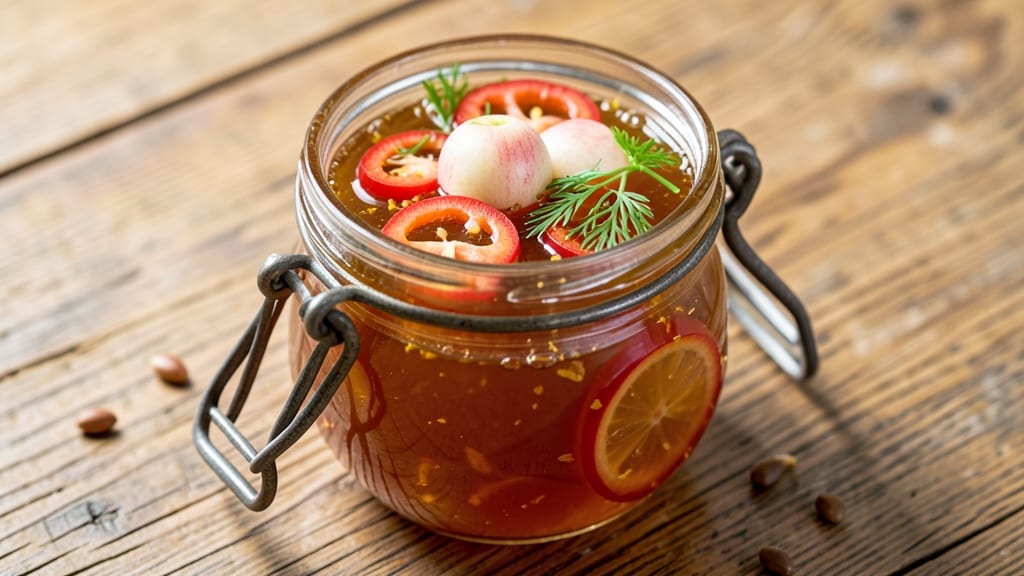
This crab apple pepper jelly recipe transforms tart fruit into a bold, balanced condiment with just the right kick.
The secret lies in blending crab apples' natural tang with subtle pepper heat, creating a jelly that's perfect for charcuterie boards or sandwiches. 🌟 What makes this recipe stand out is the careful balance of sweetness and spice—no overwhelming heat, just a gentle warmth that lingers.
The process focuses on preserving that crisp celery crunch texture in every spoonful, using a precise ratio of fruit, sugar, and pectin. You'll simmer the mixture until it reaches the perfect gel stage, ensuring a smooth yet slightly textured finish.
This isn't your average jelly—it's a sophisticated condiment that elevates any dish it touches.
What you'll end up with is a vibrant, ruby-red jelly that's tangy, slightly spicy, and perfectly sweet. The pepper adds depth without overpowering, while the crab apples keep it bright and refreshing. This jelly isn't just for spreading—it's a flavor experience that turns simple meals into something extraordinary.
Ready in about 45 minutes, this recipe delivers restaurant-quality results with minimal effort. Whether you're a seasoned canner or a beginner, the step-by-step instructions make it approachable. Let's get started on creating this unique condiment that will become a staple in your kitchen.
Ingredients for crab apple pepper jelly
Tart crab apples meet subtle pepper heat in this sophisticated condiment's bold ingredient lineup.
| Ingredient | Amount | Notes |
|---|---|---|
| Crab Apples 🍎 | 2 ½ lb | Peeled, cored, chopped |
| Granulated Sugar 🍚 | 3 cups | White or raw preferred |
| Pectin (Powdered) 🍯 | ½ oz | Low-sugar variety recommended |
| Lemon Juice 🍋 | ¼ cup | Freshly squeezed |
| Red Bell Pepper 🌶️ | 1 whole | Seeds removed, finely chopped |
| Celery Stalks 🧅 | 1 cup | Finely chopped, includes leaves |
| Fresh Ginger 🌿 | 1 tbsp | Finely grated, peeled |
| Apple Cider Vinegar 💧 | 1 tbsp | For tangy balance |
| Ground Black Pepper 🌶️ | ½ tsp | Freshly cracked |
| Pinch of Salt 🧂 | ¼ tsp | Diamond Crystal preferred |
Crab apples are the heart of this jelly, so look for vibrant, firm fruit—avoid any with soft spots. Local orchards or specialty grocers often carry them in fall, but frozen crab apples work too (thaw first). The red bell pepper adds depth without overpowering; roasted briefly enhances its flavor. Celery's crisp texture is preserved through careful chopping—include the leaves for extra brightness. For pectin, Ball or Sure-Jell are reliable choices, but check labels for low-sugar options if you're watching sweetness.
No crab apples? Substitute tart green apples—you'll need about 3 pounds to match the tartness. Swap the red bell pepper for jalapeño or Fresno peppers for more heat, but reduce to 1/2 pepper. Ginger can be omitted if you dislike its bite, but it's what ties the flavors together. For a sweeter jelly, add 1/4 cup extra sugar. The vinegar is non-negotiable—it's what keeps the jelly bright and tangy. If you're making this in summer, frozen crab apples are a great shortcut, just don't thaw them completely before cooking.
This jelly sets beautifully in small jars—4-ounce jars work perfectly for gifts. Once cooled, it keeps for up to 6 months in the pantry. For best texture, store with the lids sealed tightly. The flavor improves over time, so make a big batch. If you're canning for long-term storage, process jars in a water bath for 10 minutes—this preserves that perfect celery crunch. Reheat gently in a saucepan with a splash of water if it thickens too much.
Why You'll Love This Recipe
- No Canning Skills Needed: I swear, you don’t need fancy equipment—just a big pot, a thermometer, and 15 minutes of stirring. That red bell pepper adds depth without extra work, and the pectin does all the heavy lifting.
- Sweet-Spicy Magic: The crab apples give it that tart brightness, while the roasted red pepper sneaks in smoky warmth. Honestly, it’s the kind of flavor that makes toast taste like a celebration.
- Gift-Worthy in Minutes: Between us, this jelly is way easier to make than it is to buy. Jar it up for neighbors, holiday hosts, or your own pantry—everyone will think you’re a preserving pro.
- Uses Up Odd Ingredients: Got a bag of crab apples or a lonely bell pepper? This recipe turns them into something golden. Plus, the leftovers? Perfect for sandwiches, cheese boards, or even glaze for roasted chicken. Zero waste, all win.
Step-by-step instructions for crab apple pepper jelly
Here's how to create a vibrant, textured jelly with perfect set and bold flavors.
🍳 Step 1: Cook the Fruit Mixture to Break Down
In a large, heavy-bottomed pot, combine the 2.5 lb chopped crab apples, 1 cup finely chopped celery stalks (including leaves), 1 whole red bell pepper (seeds removed and finely chopped), and 1 tbsp finely grated fresh ginger. This vegetable blend adds depth and that signature celery crunch you'll taste in every spoonful.
Add 0.25 cup freshly squeezed lemon juice and 1 tbsp apple cider vinegar to brighten the flavors and prevent bitterness. Bring the mixture to a boil over medium-high heat, then reduce to medium-low heat and simmer uncovered for strong>25-30 minutes, stirring occasionally. You're looking for the fruit to soften completely and the mixture to reduce by about strong>one-third. The texture should be smooth with no visible chunks—this is your signal to move to the next step.
I like to press the mixture through a fine-mesh strainer at this point to remove any remaining skin or fibrous bits. This ensures your finished jelly has that silky texture we're after. Don't skip this step—those tiny fibers can make your jelly grainy.
🍳 Step 2: Add Sugar and Pectin for Perfect Gel
Return the strained fruit mixture to the pot and stir in the 3 cups granulated sugar and 0.5 oz powdered pectin. This is where the magic happens—proper sugar-to-pectin ratio is key for that perfect set. Bring the mixture back to a full rolling boil over medium-high heat, stirring constantly with a wooden spoon.
Watch carefully as the mixture thickens—it should reach a strong>full rolling boil and maintain that boil for strong>1 minute. You'll see the jelly start to thicken noticeably and coat the back of a metal spoon. This is your strong>gel point—the moment when the pectin activates and binds the liquid. If you're unsure, do the strong>sheet test: dip a metal spoon in the jelly and run your finger through it. When it leaves a clear, clean line that holds its shape, you've reached the perfect consistency.
Here's the thing—pectin works best when activated at exactly strong>220°F. If you don't reach this temperature, your jelly won't set properly. Don't walk away during this critical minute of boiling.
🔥 Step 3: Incorporate Seasonings and Test for Set
Remove the pot from heat and stir in the 0.5 tsp freshly cracked ground black pepper and 0.25 tsp Diamond Crystal pinch of salt. Let the mixture sit undisturbed for strong>5 minutes—this resting period helps the flavors meld and the pectin fully activate. The jelly should thicken slightly more during this time.
Pour a small amount of the jelly onto a chilled plate and refrigerate for strong>10 minutes. When you run your finger through it, it should hold its shape without running. If it's still too runny, return the entire pot to low heat and cook for another strong>1-2 minutes, then test again. This is especially important with this recipe—the extra vegetables can sometimes require a bit more cooking time to achieve the perfect set.
If the jelly is too thick, you can thin it with a teaspoon of hot water, but this is rare with our precise measurements. The key is patience during that initial boil—rushing leads to grainy jelly.
⏰ Step 4: Jar and Process for Shelf-Stable Jelly
Ladle the hot jelly into strong>4 clean, sterilized 8-ounce jars, leaving strong>¼-inch headspace at the top. Wipe the rims with a clean, damp cloth to ensure perfect seals. Place the lids on the jars and screw on the bands until fingertip-tight.
Process the jars in a strong>boiling water bath for strong>10 minutes. This heat treatment kills any bacteria and creates a vacuum seal. Start your timer as soon as the water returns to a full rolling boil. The jars should be completely submerged with at least strong>1 inch of water covering the tops.
After processing, remove the jars and let them cool undisturbed for strong>12-24 hours. You'll hear the satisfying strong>ping as the lids seal. Check each lid—it should be concave and not move when pressed. If any jars don't seal properly, refrigerate and use within strong>2 weeks. Properly sealed jars will keep in a cool, dark place for up to strong>1 year.
🍽️ Step 5: Enjoy with Perfect Texture and Flavor
Once cooled, your crab apple pepper jelly should have a strong>vibrant red-orange hue with visible flecks of celery and pepper. The texture should be strong>smooth yet slightly textured—that's where the celery crunch comes through in every bite. Taste and adjust seasoning if needed, though our measurements should be spot-on.
This jelly pairs beautifully with sharp cheddar on crackers, as a glaze for roasted meats, or stirred into yogurt for a unique breakfast treat. The combination of sweet crab apples, smoky pepper, and herbal celery creates a flavor profile that's truly one-of-a-kind. Store unopened jars in a cool, dark place and refrigerate after opening.
Pro Tips For Making Crab Apple Pepper Jelly
- Chop Peppers Small: I used to leave those red bell pepper chunks too big—like, seriously visible. Now I pulse them in the food processor until they’re almost paste-like. This way, every spoonful of jelly gets that subtle heat and sweetness without the texture surprises.
- Simmer, Don’t Boil: That jelly’s pectin is picky. Once the mixture hits a full rolling boil to activate the pectin, drop the heat to a gentle simmer—like a whisper, not a scream. Boiling too hard after that? You’ll end up with sugar crystals instead of a smooth set.
- Strain Twice, Strain Right: Skip the colander—use a fine-mesh sieve and a cheesecloth. The first strain catches the big bits, but the second layer (cheesecloth) grabs the tiniest apple skins and pepper seeds that’ll make your jelly grainy. Trust me, your future self will notice the difference.
- Weigh Your Sugar: Measuring sugar by volume is how you end up with a jelly that’s either too runny or too stiff. Use a kitchen scale for the exact grams—pectin works best with precision. I learned this after three batches of jelly that refused to set properly.
Essential equipment for perfect results
Heavy-Bottomed Pot
The enamel-coated Dutch oven or stainless steel stockpot is my go-to for making jelly—it distributes heat evenly and prevents scorching. I recommend a 5-6 quart pot to give you enough room for the fruit mixture to simmer properly without boiling over.
The deep sides help contain splatter from the lemon juice and vinegar. For extra insurance, I use a pot with a lid to speed up the initial cooking phase. 🔥
Fine-Mesh Strainer
A dedicated jelly bag or fine-mesh stainless steel strainer is essential for removing skins and seeds while keeping the flavorful liquid. I prefer the Ball Jelly Bag because it's specifically designed for this purpose—it sits over a bowl and lets you press out every last drop of juice.
If you don't have one, a fine-mesh sieve with a rubber spatula works too, but you'll need to work in batches. The smoother your strained mixture, the better your jelly will set.
Wooden Spoon
Never use metal utensils when working with jelly—aluminum or stainless steel spoons can react with the acidity and affect the pectin's ability to gel properly. A long-handled wooden spoon is perfect for stirring during the critical boiling phase.
I keep one dedicated to jelly-making because it's gentle on the pot and won't scratch the enamel. The slightly rough surface also helps scrape up any jelly clinging to the sides during the final boil. 🌟
Instant-Read Thermometer
Pectin needs to reach exactly 220°F to activate properly, and an instant-read thermometer is the only reliable way to monitor this. I use the ThermoWorks Thermapen ONE because it's fast and accurate.
Insert it into the simmering mixture during the final boil—if it doesn't hit 220°F, your jelly may not set correctly. This is especially important with our pepper-infused recipe, as the extra vegetables can sometimes lower the temperature slightly. Don't guess—measure!
Canning Supplies
For safe storage, you'll need new lids, bands, and sterilized jars—I recommend Ball or Kerr canning kits for beginners. The 8-ounce jars are perfect for this recipe, giving you generous portions while being easy to handle.
Sterilize jars by boiling them for 10 minutes in a water bath or running them through a dishwasher's sanitize cycle. Don't reuse old lids—they won't seal properly. I also keep a jar lifter and bubble remover handy for processing day.
The lifter is a game-changer when moving hot jars in and out of boiling water.
Plate for Gel Test
A chilled glass or ceramic plate is crucial for testing your jelly's set. Place it in the freezer for 10 minutes before using—this helps you see the jelly's consistency more clearly. After spooning a small amount of jelly onto the plate, I wait 5 minutes before testing.
The plate should be level, and you'll need a clean, dry finger to draw a line through the jelly. If the line holds its shape, your jelly is ready for jars. Pro tip: Keep a small notebook nearby to track your tests—it helps you troubleshoot if something goes wrong. ✨
Nutrition facts
Frequently asked questions
Why does this jelly have celery in it?
The celery adds a subtle herbal brightness that balances the sweetness and pepper heat. When finely chopped and cooked down, it creates a signature "crunch" texture in every spoonful—almost like tiny flecks of freshness. The leaves add extra flavor without overpowering the tart crab apple base.
Can I make this jelly without pectin?
Yes, but the texture will be more syrup-like. For a gelled consistency, use 1 packet (1.75 oz) powdered pectin instead of the 0.5 oz called for. If you prefer no pectin, reduce sugar to 2 cups and expect a runnier spread that's great for drizzling or glazing.
How do I adjust the spice level?
For milder heat, reduce the pepper to ½ whole bell pepper or swap for ½ jalapeño. For extra kick, add ½ tsp cayenne with the black pepper. Always taste before canning—flavor develops as it cools, so adjust gradually.
Will this jelly be too tart for kids?
The sugar balances the tartness beautifully, but you can reduce it to 2 cups for a lighter sweetness. For picky eaters, serve it with mild cheeses or on buttered toast where the flavors blend. The pepper adds warmth rather than heat, making it kid-friendly in small amounts.
Can I use frozen crab apples?
Thaw them first, then drain well to avoid excess moisture. Frozen apples work perfectly—they're often pre-peeled and cored, saving prep time. Just pat them completely dry before cooking to prevent a watery jelly.